Audiometric Test Methods (ISO 8253-1 and -2)
Standards: ISO 8253
An audiogram is a set of hearing threshold levels, and each of them rests on three things the audiometer does not show: a room quiet enough not to mask the faintest tone, a rule that turns a series of “heard” and “not heard” into one number, and an uncertainty that says how far that number can be trusted. ISO 8253-1 sets all three out for earphones and bone vibrators, and ISO 8253-2 adds what a loudspeaker needs: a room whose sound field is known.
Is the room quiet enough? (ISO 8253-1 Clause 11)
Section titled “Is the room quiet enough? (ISO 8253-1 Clause 11)”The ambient noise must not mask the lowest test tone. Tables 2 and 4 give the maximum permissible ambient sound pressure level in each one-third-octave band from 31.5 Hz to 8 kHz, for air conduction with typical supra-aural earphones and for bone conduction, and for the lowest frequency the audiometry tests: 125 Hz, 250 Hz or, with earphones, 500 Hz. They hold for hearing threshold levels down to 0 dB with at most +2 dB of threshold shift from the noise. Three things move them (11.1 and the NOTEs to the tables):
an earphone that excludes more noise than the supra-aural one allows the difference of the two attenuations in Table 3; a lowest hearing threshold level other than 0 dB is added band by band; and accepting a threshold shift of +5 dB instead of +2 dB adds = 8 dB.
import numpy as npfrom phonometry import hearing
# One-third-octave ambient levels of a single-walled booth, 31.5 Hz to 8 kHz.booth = [50, 48, 45, 43, 40, 36, 30, 24, 19, 16, 14, 12, 11,         10, 10, 10, 9, 9, 9, 8, 8, 8, 8, 8, 8]supra_aural = hearing.check_audiometric_ambient_noise(booth)print(supra_aural.passes)                               # Falseprint(supra_aural.frequencies[~supra_aural.within])     # [ 63.  80. 100. 125. 160.]print(supra_aural.lowest_measurable_hearing_level_db)   # 3.0
# The same booth with insert earphones (Table 3: about 33 dB at low frequency).insert = hearing.check_audiometric_ambient_noise(booth, earphone="ER-3A")print(insert.passes)                                    # Trueprint(hearing.ambient_noise_limits("air", earphone="ER-3A")[15])  # 45.0 at 1 kHz
The booth’s ventilation leaves too much at 63 Hz to 160 Hz for supra-aural
earphones, by up to 3 dB at 100 Hz, so with them it can only measure down to a
hearing level of 3 dB: the lowest level the rule of 11.1 allows this room.
ISO 8253-1 asks no report to state it; ISO 8253-2 11.1 f) asks a sound field
report to state the same figure when it is not 0 dB. Insert earphones exclude
that noise, and the same room qualifies. Another earphone enters with its own
attenuation per band, earphone_attenuation_db=.
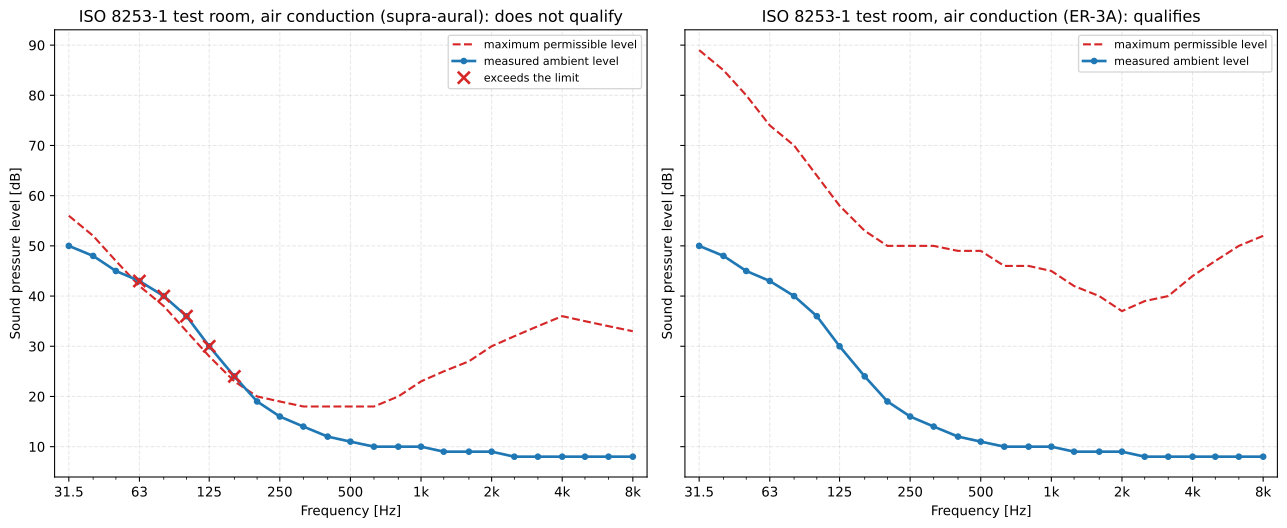
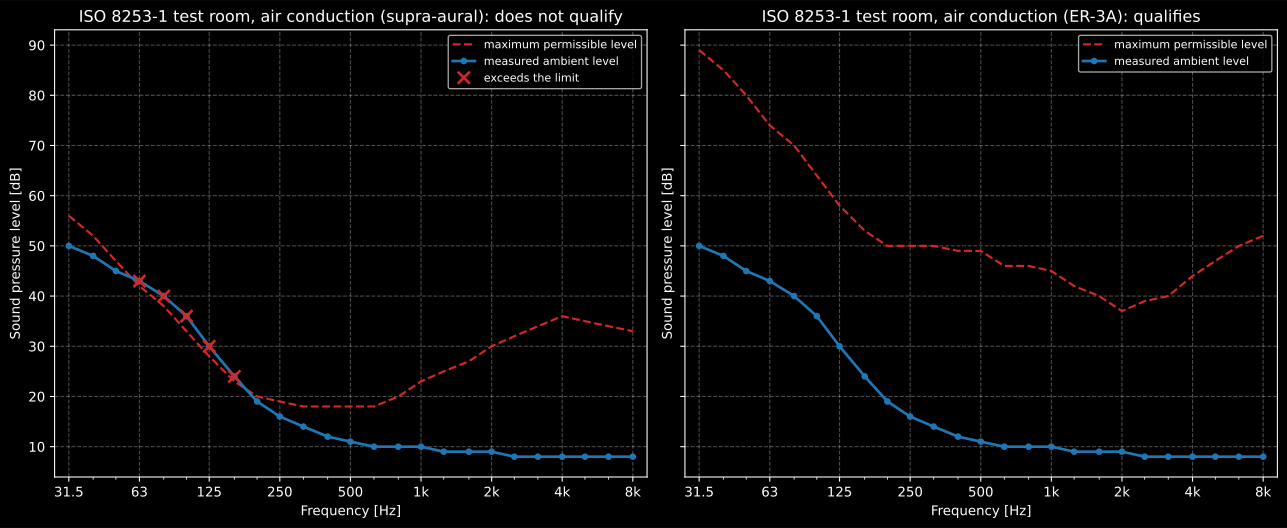
One booth, two earphones. The limits of Table 2 are what a supra-aural earphone lets through; an insert earphone excludes about 30 dB more below 500 Hz, and Table 3 turns that into room.
Show the code for this figure
import matplotlib.pyplot as plt
fig, (left, right) = plt.subplots(1, 2, figsize=(13.5, 5.6), sharey=True)supra_aural.plot(left)   # limits, measured spectrum, crosses where it exceedsinsert.plot(right)plt.show()
Bone conduction leaves both ears open, so no earphone shelters them and Table 4 is stricter than Table 2 by 10 dB at 500 Hz and by 34 dB at 4 kHz; NOTE 2 to it warns that levels under 5 dB are hard to measure with most sound level meters. The same booth, for bone conduction from 250 Hz, allows only a lowest hearing level of 6 dB, set by the 4 kHz band:
bone = hearing.check_audiometric_ambient_noise(    booth, presentation="bone", lowest_test_frequency_hz=250)print(bone.passes, bone.lowest_measurable_hearing_level_db)   # False 6.0print(bone.frequencies[np.argmax(bone.exceedance_db)])        # 4000.0
# Measuring only down to 10 dB raises every limit by 10 dB (11.1).print(hearing.check_audiometric_ambient_noise(    booth, presentation="bone", lowest_test_frequency_hz=250,    lowest_hearing_level_db=10.0,).passes)                                                     # True
A measurement that leaves bands out is judged on those it has and does not
pass: the room is not shown to meet the bands nobody measured. noise_floor_db=
flags the bands where the reading is within 6 dB of the meter’s own floor,
which 11.1 forbids; such a reading overstates the room, so a band within its
limit still is, and one over it may be the meter’s.
From responses to a threshold (6.2 to 7.5)
Section titled “From responses to a threshold (6.2 to 7.5)”Every method ends in a rule, and each rule has its own test of reliability: a spread of more than 10 dB between the levels it combines.
The ascending method (6.2.3.2, 6.2.4.2)
Section titled “The ascending method (6.2.3.2, 6.2.4.2)”The first tone sits 10 dB below the lowest level the subject answered during familiarization; after no response the level rises 5 dB, after a response it drops 10 dB. An ascent is a run of rising tones that ends in a response, and the series stops when three ascents end at one level, out of at most five. The hearing threshold level is the lowest level at which responses occur in more than half of the ascents:
series = hearing.ascending_method_threshold(    presentation_levels_db=[30, 20, 25, 15, 20, 25, 15, 20, 10, 15, 20, 25],    responses=[1, 0, 1, 0, 0, 1, 0, 1, 0, 0, 0, 1],    familiarization_level_db=40.0,)print(series.ascent_levels_db)   # [25. 25. 20. 25.]print(series.threshold_db)       # 25.0print(series.doubtful)           # False: the ascents span 5 dB, not over 10 dB
# Replayed as it happens, the same rule says what to present next.print(hearing.ascending_method_threshold(    presentation_levels_db=[30, 20], responses=[True, False],    familiarization_level_db=40.0,).next_level_db)                 # 25.0
The sequence is checked against the steps of 6.2.3.2, and a tone that breaks
them is refused with its position, which is what lets the function supply the
next level to a computer-controlled audiometer (6.4): call it with the
presentations so far and present next_level_db. The first tone, heard at once, is not an ascent: no
tone rose to it. After five ascents without three at one level the series is
exhausted and the next starts 10 dB above the last response. The response levels
of the ascents can go in alone, and shortened=True applies the version that
stops at two responses out of three ascents. 6.2.3.2 does not say what follows
a shortened series that ends its three ascents without two responses at one
level; the library continues it with the full method, a new call on the same
presentations with shortened=False.
The bracketing method (6.2.4.3)
Section titled “The bracketing method (6.2.4.3)”Ascents and descents alternate in 5 dB steps. The lowest response levels of the ascents are averaged, those of the descents are averaged, and the mean of the two averages, rounded to the nearest 5 dB step, is the threshold. A mean halfway between two steps goes to the higher one, the library’s reading of “nearest” wherever a standard leaves the tie open:
bracket = hearing.bracketing_method_threshold([30, 30, 35], [30, 35, 35])print(bracket.mean_db, bracket.threshold_db) # 32.5 35.0print(bracket.complete, bracket.repeat_advised) # True FalseThree ascents and three descents make a complete series; two of each suffice when their four levels are within 5 dB of each other.
Automatic recording (6.3.5)
Section titled “Automatic recording (6.3.5)”The subject holds the level down while the tone is heard and lets it rise when it is not, and the tracing zigzags about the threshold. The first reversal after a change of frequency is ignored, and so are both reversals of any excursion of 3 dB or less; the peaks and the valleys are averaged separately, and the mean of the two averages, rounded up to the next whole decibel, is the threshold:
tracing = hearing.automatic_audiometry_threshold( [38, 22, 31, 21, 32, 20, 30, 29, 31, 19, 30, 20, 31, 21])print(tracing.peaks_db) # [31. 32. 30. 31.]print(tracing.valleys_db) # [22. 21. 20. 19. 20. 21.]print(tracing.mean_db, tracing.threshold_db) # 25.75 26.0The recording is of doubtful reliability when the peaks or the valleys spread over more than 10 dB or fewer than six reversals remain. NOTE 2 to 6.3.5 puts automatic thresholds 3 dB below manual ones on average, a property of the method this function does not correct.
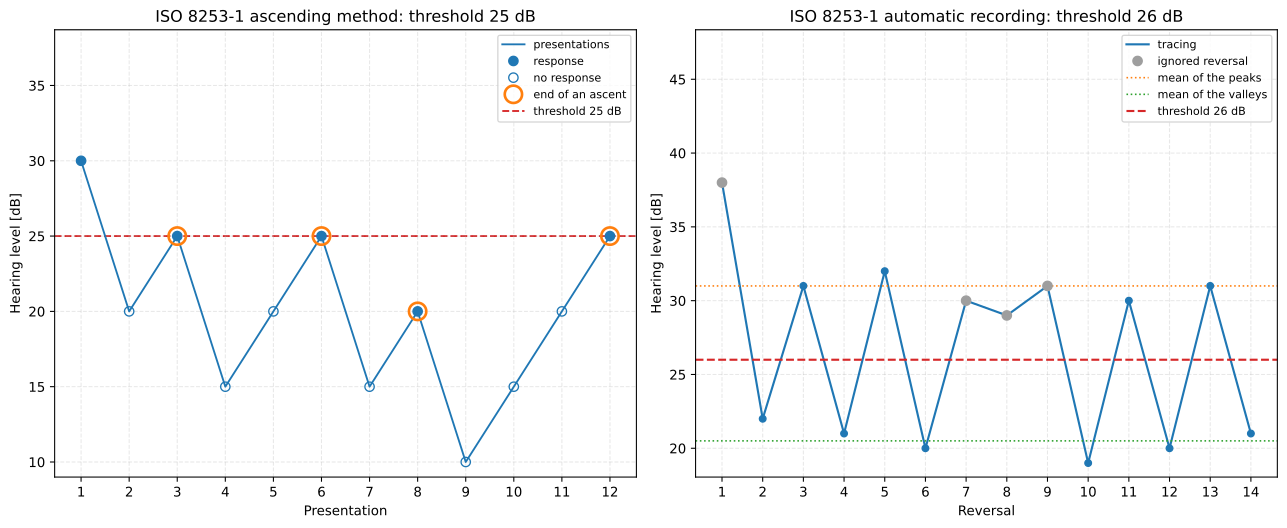
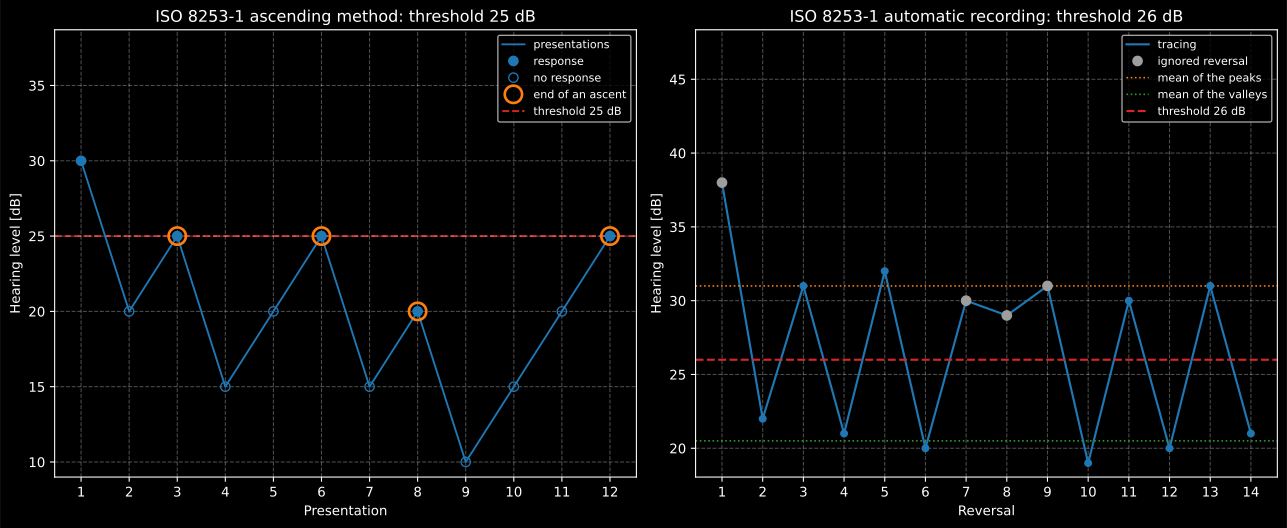
Left, the ascending method: three of the four ascents end at 25 dB, which is more than half. Right, automatic recording: the peaks average 31 dB and the valleys 20.5 dB, and the mean of 25.75 dB is rounded up.
Show the code for this figure
fig, (left, right) = plt.subplots(1, 2, figsize=(13.5, 5.6))series.plot(left) # the staircase, heard and missed, ascents ringedtracing.plot(right) # the tracing, its ignored reversals and the averagesplt.show()Sweep-frequency audiometry (7.5)
Section titled “Sweep-frequency audiometry (7.5)”The frequency sweeps, normally at 0.5 to 2 octaves per minute, while the subject tracks the threshold. At a specified frequency the three peaks and the three valleys closest to it are averaged, closest on the logarithmic axis the sweep runs on, and the mean is rounded to the nearest decibel. Run along the tracing, six consecutive reversals give the threshold at the geometric mean of their frequencies:
reversal_frequencies = np.geomspace(500.0, 4000.0, 18)reversal_levels = [34, 24, 33, 23, 35, 25, 36, 24, 38, 27, 40, 29, 43, 31, 46, 34, 48, 37]sweep = hearing.sweep_audiometry_threshold(reversal_frequencies, reversal_levels)print(sweep.frequencies) # [ 500. 750. 1000. 1500. 2000. 3000. 4000.]print(sweep.threshold_db) # [29. 29. 30. 32. 36. 40. 40.]print(np.round(sweep.running_frequencies[:2])) # [679. 767.]The repeat at 1 kHz and the cautions (6.2.3.2, 8.4)
Section titled “The repeat at 1 kHz and the cautions (6.2.3.2, 8.4)”Three more rules judge the levels once they are found. When every frequency of the first ear is done, Step 3 of 6.2.3.2 repeats the measurement at 1 kHz: an agreement to 5 dB or less moves the test to the other ear, and an improvement or a worsening of 10 dB or more sends it back to retest the further frequencies, in the same order, until the agreement returns. A hearing level of 40 dB or more in either ear calls for caution because the tone may be heard by the other ear, and contralateral masking can then be necessary (6.2.3.2). And a bone vibrator on the mastoid is felt, on average, at a hearing level of about 40 dB at 250 Hz, 60 dB at 500 Hz and 70 dB at 1 kHz (8.4, about 10 dB lower when the audiometer is calibrated for the forehead), so a bone-conduction response there may be touch rather than hearing:
repeat = hearing.check_retest_agreement(25.0, 35.0)   # first and repeat at 1 kHzprint(repeat.passes, repeat.retest_further_frequencies)   # False True
cautions = hearing.audiogram_cautions(    [250, 500, 1000, 2000, 4000],    air_conduction_db=[20, 25, 30, 45, 55],    bone_conduction_db=[40, 20, 25, 40, 50],)print(cautions.cross_hearing)   # [False False False  True  True]print(cautions.vibrotactile)    # [ True False False False False]
The text is written for the 5 dB steps of a manual audiometer, where a repeat
either agrees to 5 dB or differs by 10 dB. A finer control can give 7 dB, which
is not agreement, and for which Step 3 names no action; the check then neither
passes nor asks for the retest. 8.4 gives levels at three frequencies only and
warns that individuals vary widely about them, so a flag there is a reason to
look again, not a verdict; bone conduction gets no cross-hearing flag, because
8.1 already asks for the other ear to be masked at every level.
cautions.plot() draws the audiogram with the flagged levels crossed.
The uncertainty of a threshold (Annex A)
Section titled “The uncertainty of a threshold (Annex A)”Annex A models the hearing threshold level as the determined value plus seven zero-mean input quantities, for the audiometer, the transducer and its fitting, the ambient noise, the masking, the tester, the subject and an unusually difficult measurement. None is correlated with another and each has a sensitivity coefficient of 1, so
and A.3 gives typical values: 2.5 dB for repeated air-conduction determinations up to 4 kHz, the audiometer’s ±3 dB and its 5 dB steps as two rectangular distributions, = 2.9 dB for the transducer, and 2 dB for a room that meets Clause 11. That is the example of Table A.2:
budget = hearing.audiometric_uncertainty(1000.0)print(np.round(budget.components_db[:4], 1))           # [2.5 2.3 2.9 2. ]print(round(budget.combined_db, 1), round(budget.expanded_db))  # 4.9 10
# Bone conduction above 4 kHz with masking noise: every component grows.masked_bone = hearing.audiometric_uncertainty(6000.0, conduction="bone", masked=True)print(round(masked_bone.expanded_db, 1))               # 15.3
An expanded uncertainty of 10 dB is two audiometer steps either way, which is
what a single audiogram can claim. environment_db= replaces the 2 dB of A.3.5
for a room that exceeds Clause 11, or drops it for thresholds well above 0 dB,
and tester_db=, subject_db= and special_db= carry the exceptional
components of A.3.7 to A.3.9; budget.plot() draws the eight as bars.
The sound field (ISO 8253-2)
Section titled “The sound field (ISO 8253-2)”With loudspeakers the room is part of the instrument, so ISO 8253-2 qualifies it, with the subject and the chair absent and the audiometry’s own signals, as one of three fields:
- a free field (5.2): the loudspeaker at least 1 m away, the level 0.15 m to the left, right, above and below the reference point within ±1 dB of the level at it up to 4 kHz and ±2 dB above, the ear-side positions within 3 dB of each other above 4 kHz, and the points 0.15 m in front of and behind it on the loudspeaker’s axis within ±1 dB of the inverse distance law, . Only an anechoic room meets it, and pure tones need it (4.2);
- a quasi-free field (5.4): the same with ±2 dB at the lateral positions and the axial points 0.10 m out. Its usable frequency range is the range where the requirements hold;
- a diffuse field (5.3): six positions 0.15 m out within ±2.5 dB and the ear sides within 3 dB, and from 500 Hz up the levels a directional microphone reads in the directions of the most and the least incident energy within the variation Table 1 allows for its front-to-random index: 5 dB for an index of 5 dB or more, 4.5 dB for 4.5 dB, 4 dB for 4 dB.
# A treated room, the loudspeaker 1.2 m away: deviations from the level at# the reference point, 125 Hz to 8 kHz, at the four lateral positions.lateral = {    "left": [2.6, -2.2, 0.8, 0.6, -0.4, 0.5, 0.9, -0.7, 1.2, -1.1, 1.4],    "right": [-2.4, 1.9, -0.6, 0.3, 0.7, -0.8, 0.4, 1.1, -1.3, 1.5, -0.9],    "up": [1.2, 2.3, 0.5, -0.9, 0.2, 0.6, -0.5, 0.8, 0.4, -1.2, 1.6],    "down": [-1.5, -1.8, -0.9, 0.4, -0.6, -0.3, 0.7, -0.4, -0.8, 0.9, -1.7],}law = 20 * np.log10(1.3 / 1.1)   # the axial difference at 0.10 m, 1.45 dBfront = law + np.array([1.8, 1.2, 0.4, -0.3, 0.2, -0.4, 0.3, 0.5, -0.2, 0.6, -0.5])quasi = hearing.check_quasi_free_sound_field(    lateral, np.zeros(11), front_levels_db=front, back_levels_db=np.zeros(11),    loudspeaker_distance_m=1.2,)print(quasi.passes)              # False: the room's modes spoil 125 Hz and 250 Hzprint(quasi.usable_frequencies)  # [ 500.  750. 1000. 1500. 2000. 3000. 4000. 6000. 8000.]
# Four loudspeakers with uncorrelated narrow bands of noise: the six positions,# and a directional microphone of index 5 dB read in two directions.six = {    "front": [1.4, 0.9, 0.6, -0.8, 0.5, 1.1, -0.4, 0.7, -0.6, 0.9, 1.2],    "back": [-1.2, -0.6, 0.8, 0.5, -0.9, -0.7, 0.6, -0.5, 0.8, -1.0, -0.8],    "left": [0.8, 1.3, -0.5, 0.9, 0.4, -0.6, 1.0, 0.6, -0.9, 0.5, 1.4],    "right": [-0.9, -1.1, 0.7, -0.4, -0.8, 0.9, -0.7, -0.8, 0.7, -0.6, -1.1],    "up": [2.1, 1.6, -1.1, 0.6, 1.2, -0.9, 0.8, -1.2, 0.5, 1.3, -0.7],    "down": [-1.8, -1.4, 0.9, -1.0, -0.5, 0.8, -1.1, 0.9, -0.4, -0.9, 0.6],}readings = np.zeros((2, 11))readings[1] = [np.nan, np.nan, 3.1, 2.7, 3.4, 2.9, 3.8, 3.2, 3.6, 4.1, 4.3]diffuse = hearing.check_diffuse_sound_field(    six, np.zeros(11), directional_levels_db=readings, front_to_random_index_db=5.0)print(diffuse.passes)            # True
The directional test of 5.3 b) is a requirement, not an extra: without the
readings, diffuse.directionality_judged is false and so is passes, while
uniform and balanced still give the verdict of a) band by band. A
microphone of index 4 dB would allow only 4 dB and fail the 6 kHz and 8 kHz
bands of the same readings. The sound-field room also has its own ambient limits,
ISO 8253-2 Table 2 up to 12.5 kHz, derived from ISO 8253-1 for binaural
listening (footnote a); laid side by side, they are its bone-conduction limits
less 3 dB: check_audiometric_ambient_noise(levels, presentation="sound field").
With narrow bands of noise as the test signal, as in this diffuse field,
footnote b asks for lower limits than the table’s and prints no figure, so a
room that passes the check may still be too loud for them.
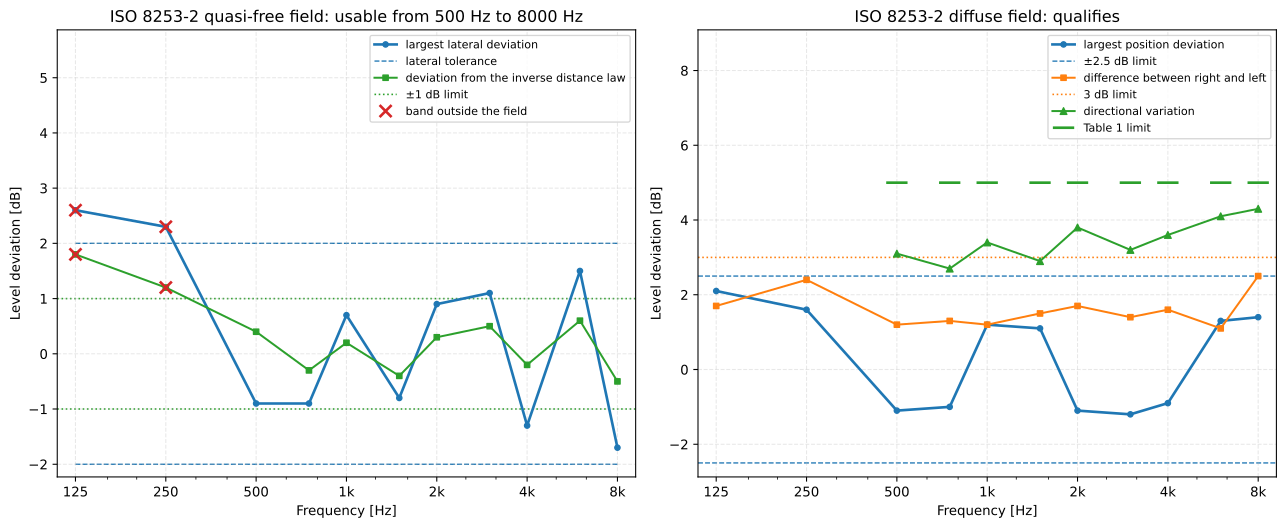
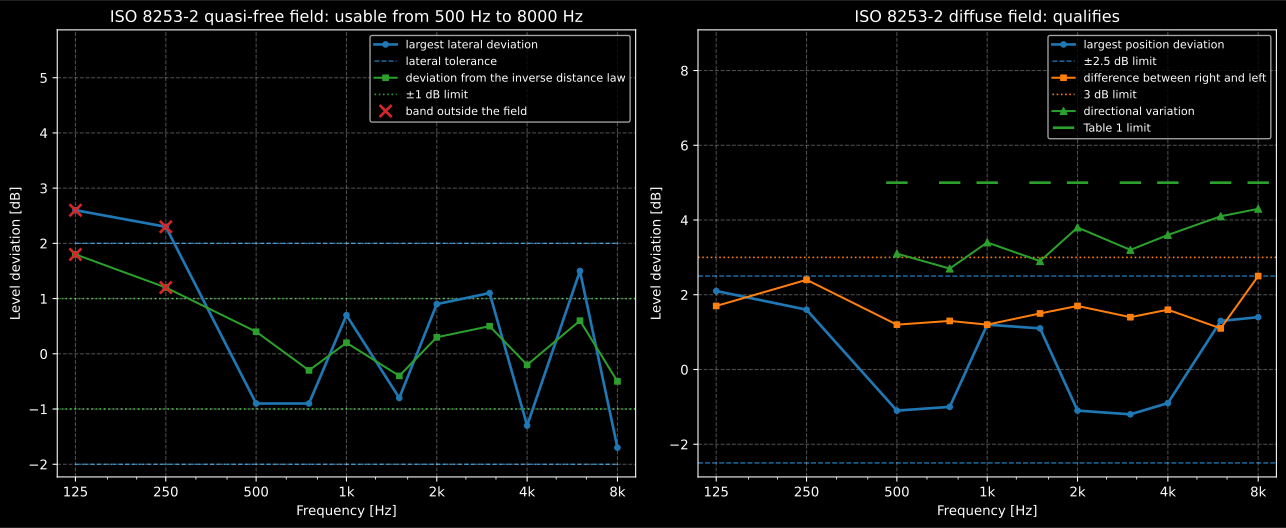
Left, 5.4: the usable frequency range of a quasi-free field is where it meets its requirements, here 500 Hz to 8 kHz. Right, 5.3: a diffuse field made of four loudspeakers, qualified with a directional microphone of index 5 dB.
Show the code for this figure
fig, (left, right) = plt.subplots(1, 2, figsize=(13.5, 5.6))quasi.plot(left) # lateral and axial deviations, bands outside crosseddiffuse.plot(right) # positions, ear sides and directional variationplt.show()No standardized reference threshold exists for a loudspeaker away from 0° (4.8, NOTE 1). Annex B prints how much higher the level is at the ear nearer the loudspeaker at 45° and 90°, rounded to 0.5 dB, which is what a report can state beside an off-axis threshold:
print(hearing.incidence_correction([500, 1000, 4000], incidence_angle_deg=90))# [ 4.5 5.5 -0.5]The paragraph above Table B.1 announces it from 200 Hz; the table prints rows from 125 Hz, and the library keeps every printed row. The discrepancy is registered in ERRATA.
What this guide covers
Section titled “What this guide covers”Covered
ISO 8253-1:2010’s maximum permissible ambient levels of Clause 11 (Tables 2 and 4) with the earphone allowance of Table 3, the lowest hearing threshold level and the +5 dB relaxation, and the noise-floor margin of 11.1; the threshold rules of the ascending method (6.2.3.2 and 6.2.4.2, with its full and shortened series and the replay of a presentation sequence), the bracketing method (6.2.4.3), automatic recording (6.3.5) and sweep-frequency audiometry (7.5), each with its reliability test; the repeat at 1 kHz of 6.2.3.2 Step 3, the cross-hearing caution of 6.2.3.2 and the vibrotactile levels of 8.4; and the uncertainty budget of Annex A (A.3 to A.5), via
hearing.check_audiometric_ambient_noise,hearing.ambient_noise_limits,hearing.ascending_method_threshold,hearing.bracketing_method_threshold,hearing.automatic_audiometry_threshold,hearing.sweep_audiometry_threshold,hearing.check_retest_agreement,hearing.audiogram_cautionsandhearing.audiometric_uncertainty. Every cell of Tables 2 to 4, the levels of 8.4, the components of A.3.3 and A.3.4 and the budget of Table A.2 (its four components, = 4.9 dB and = 10 dB) are reproduced in the test suite and in the conformance report.Covered
ISO 8253-2:2009’s free, quasi-free and diffuse sound fields (5.2 to 5.4, with Table 1), the ambient limits of Clause 6 and Table 2, and the off-axis increases of Annex B (Table B.1), via
hearing.check_free_sound_field,hearing.check_quasi_free_sound_field,hearing.check_diffuse_sound_field,hearing.check_audiometric_ambient_noiseandhearing.incidence_correction. Every cell of Tables 2 and B.1 is reproduced in the test suite and in the conformance report, and so is the derivation of Table 2 from ISO 8253-1 Table 4. The diffuse-field check is the one ISO 4869-3 applies to the random-incidence field of its test site, on the hearing protectors page.Not covered
Nothing here presents a tone, drives an audiometer’s hardware or judges a subject. The preparation and instruction of the subject (Clause 5), the familiarization of 6.2.2, the masking procedures of 6.2.3.3 and 8.5, the screening test of Clause 9, the audiogram symbols of Clause 10 and the psycho-acoustic check of 11.2 are procedures a tester follows, and the calibration scheme of Clause 12 belongs to IEC 60645-1 and the ISO 389 series. The test signal characteristics of ISO 8253-2 Clause 4, its monaural and binaural testing (8.2, 8.3) and testing with a hearing aid (Clause 9) are likewise taken as given, and so are the lower ambient limits footnote b to its Table 2 asks for narrow-band noise, for which it prints no figure. Speech audiometry is ISO 8253-3, which the library does not implement. The reference zero the thresholds are levels above is on the hearing threshold page.
References
Section titled “References”- International Organization for Standardization. (2009). Acoustics — Audiometric test methods — Part 2: Sound field audiometry with pure-tone and narrow-band test signals (ISO 8253-2:2009). The free, diffuse and quasi-free sound fields of 5.2 to 5.4 with Table 1, the ambient limits of Clause 6 and Table 2, and the off-axis increases of Annex B, validated against every cell of Tables 2 and B.1.
- International Organization for Standardization. (2010). Acoustics — Audiometric test methods — Part 1: Pure-tone air and bone conduction audiometry (ISO 8253-1:2010). The implemented standard: the maximum permissible ambient levels of Clause 11 with Tables 2 to 4, the threshold rules of 6.2.4, 6.3.5 and 7.5, and the uncertainty budget of Annex A, validated against every cell of Tables 2 to 4 and against Table A.2. Read in its European adoption BS EN ISO 8253-1:2010, which adopts it without modification.