Service-Equipment and Activity Noise (ISO 16032)
Standards: E DIN EN ISO 16032
A neighbour’s toilet flushing at night, a lift motor behind a bedroom wall, a ventilation outlet that hums, or the bar downstairs: the number a building regulation puts on them comes from ISO 16032, the engineering method for the sound pressure level that service equipment makes in a room. Its revision widens the scope from installed equipment to activities, sources in or near the building whose operation nobody on site controls, such as sports facilities, pubs and amplified music.
The library implements the revision from its draft, ISO/DIS 16032:2023, published in Germany as E DIN EN ISO 16032:2023-05. The published second edition is not available to the project; the draft is the only text of the revision there is, so everything the library implements follows it, and it is cited as a draft, with its own clause numbers. The withdrawn 2004 edition is used only to say what changed. The survey method for the same quantities is ISO 10052, and the prediction of the structure-borne part of equipment noise is EN 12354-5.
Where it applies. Clause 1 intends the method for rooms of about 300 m³ or less, in dwellings, hotels, schools, offices and hospitals. It is not meant for large auditoriums and concert halls, nor for a source so far from the building that the weather changes how the sound gets there, although the operating conditions of Annex B can still be used in such cases.
What the method measures
Section titled “What the method measures”The linear band spectrum is recorded together with the A- or C-weighted level (a multispectral recording, Clause 6) in one of three quantities: the maximum level with time weighting S or F, read at the instant the weighted level peaks, or the equivalent continuous level over an integration time. The single numbers are then computed from the bands, never read off the meter, and Table 1 names them:
| A-weighted | C-weighted | |
|---|---|---|
| Maximum, time weighting S | , , | , , |
| Maximum, time weighting F | , , | , , |
| Equivalent continuous | , , | , , |
The draft is explicit that these are not interchangeable: only results obtained with the same method are compared, and a result compared with a legal requirement has to be the quantity the requirement names. The library keys every single number by exactly this notation.
Where the microphones go (7.2 and 7.3)
Section titled “Where the microphones go (7.2 and 7.3)”Position 1 is a corner. The corner with the highest C-weighted level is found first, by the maximum level with S or F or by the equivalent level, under the chosen operating conditions or any steady condition that finds the loudest corner. A hand-held integrating meter will do: no band calculation, no correction. The microphone goes preferably 0.5 m from the two walls and the floor, raised to 1.0 m or 1.5 m where furniture is in the way, and at least 0.2 m from any obstacle. A corner dominated by direct sound from a source in the room, a ventilation outlet for example, is left out of the search.
Positions 2 and 3 are in the reverberant field. They keep preferably 1.5 m, and at least 1.0 m, from each other and from the corner position; 1.5 m from any sound source in the room; 0.50 m from every room surface (0.30 m in a small room where that cannot be met); and a height from 0.5 m to 2.0 m.
loudest_corner picks position 1 from the corner readings, and
check_service_equipment_positions holds a set of positions in a rectangular
room to the distances and heights of 7.3, and the corner to its height of
0.5 m to 1.5 m. The two preferences, the corner 0.5 m from its walls and the
positions 1.5 m apart, are reported as preferred_corner_wall_distance and
preferred_separation and do not decide passes:
import numpy as npfrom phonometry import building
# The loudest corner of four, C-weighted and read directly.corner = building.loudest_corner([47.8, 49.3, 51.6, 50.2])print(corner)                   # 2: the third corner, counted from 0
# A 4.2 m x 3.4 m x 2.5 m bedroom next to the bathroom.positions = building.check_service_equipment_positions(    (4.2, 3.4, 2.5),                            # length, width, height [m]    (3.7, 2.9, 0.5),                            # position 1, in that corner    [(1.4, 1.9, 1.2), (3.1, 0.8, 1.5)],         # positions 2 and 3    source_positions_m=[(0.6, 3.0, 2.5)],       # a supply outlet in the ceiling)print(positions.passes, round(positions.separation_m, 2))   # True 2.05print(positions.preferred_corner_wall_distance)             # True: 0.5 m from both wallspositions.plot()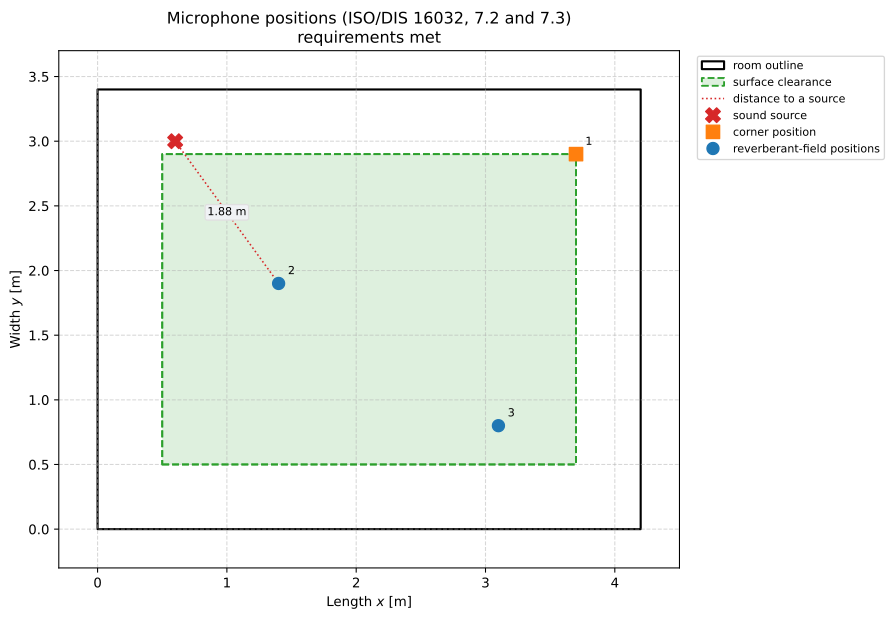
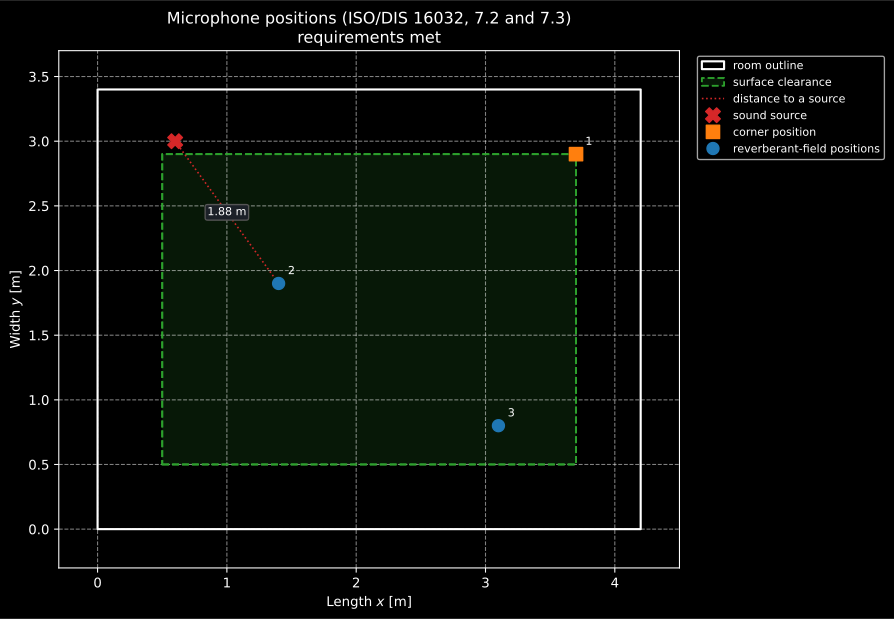
The plan cannot show a distance in three dimensions: the outlet is in the ceiling and position 2 is 1.2 m high, so the two are 1.88 m apart although they look closer. The figure joins each source to its nearest position and writes the true distance on the line.
A room outline cannot show furniture, so the 0.2 m that 7.2 asks between the
corner microphone and any obstacle is judged from the distance measured on
site. Pass it as corner_obstacle_distance_m, one value or one per obstacle
near the microphone: the nearest decides corner_obstacle_ok, which then
enters passes, and 0.2 m itself is “at least 0.2 m”. Left out, it is not
judged. The choice of corner stays with the person placing the microphone.
positions = building.check_service_equipment_positions( (4.2, 3.4, 2.5), (3.7, 2.9, 0.5), [(1.4, 1.9, 1.2), (3.1, 0.8, 1.5)], source_positions_m=[(0.6, 3.0, 2.5)], corner_obstacle_distance_m=[0.35, 0.25], # a wardrobe and a radiator [m])print(positions.corner_obstacle_distance_m, positions.passes) # 0.25 TrueA source in the room gets a position of its own (7.9). Where a source
stands in the room itself, a ventilation outlet in the wall or in the ceiling
for example, one additional position is measured for each: 1 m in front of a
wall source at 1.5 m above the floor, or 1.5 m above the floor directly below
a ceiling source. Its result is reported separately, never standardized or
normalized, and not averaged with positions 1, 2 and 3.
additional_microphone_position places it in the same coordinates:
extra = building.additional_microphone_position( (4.2, 3.4, 2.5), (0.6, 3.0, 2.5), mounting="ceiling")print(extra) # [0.6 3. 1.5]How many positions (7.4.1)
Section titled “How many positions (7.4.1)”The A-weighted readings of positions 1, 2 and 3, as the instrument shows them without any correction, decide whether three are enough. If they are within 3.0 dB of each other the corrections follow. Otherwise the corner is measured again with two new room positions, 4 and 5, and the six have to be less than 6.0 dB apart; failing that, the corner once more with positions 6 and 7, and the nine less than 9.0 dB apart. A difference larger than 9.0 dB that comes from unpredictable variations in time, while the corner readings show a steady source, interrupts the session: the cause is investigated before a new series, and no reading of the interrupted one is used. The same ladder applies to a maximum level (7.4.2), where the sound exposure level may stand in for short events.
check_position_spread takes the readings in that order (corner, 2, 3, then
corner, 4, 5 and corner, 6, 7) and says what comes next:
first = building.check_position_spread([34.1, 31.2, 35.6])print(first.action, first.next_positions)       # add_positions (4, 5)
second = building.check_position_spread([34.1, 31.2, 35.6, 33.9, 32.4, 34.8])print(second.action, round(second.corner_standard_deviation_db, 2))  # proceed 0.14second.plot()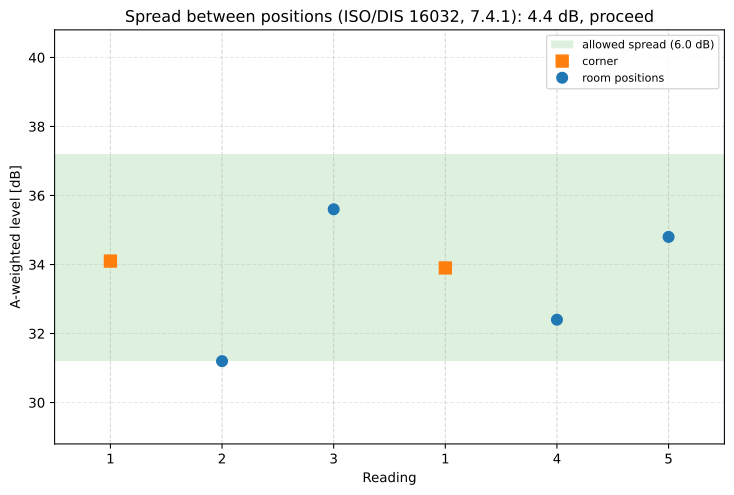
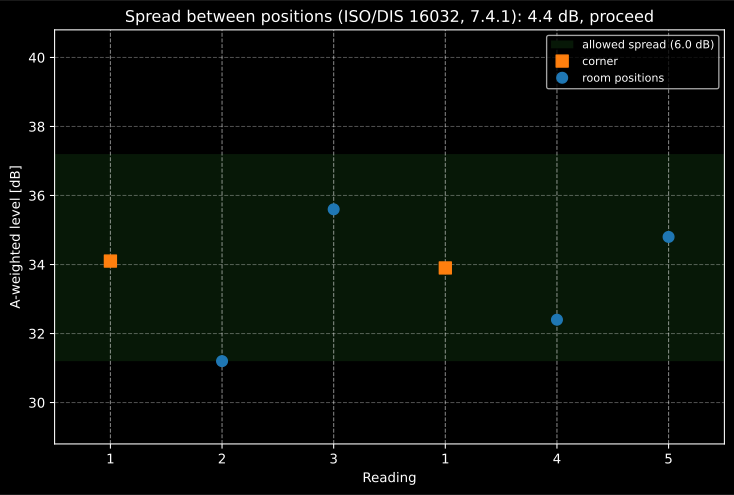
The first three readings are 4.4 dB apart, past the 3.0 dB of the first stage; with positions 4 and 5 the six are still 4.4 dB apart, under the 6.0 dB the second stage allows, so the method proceeds with all six. The corner, measured twice, is the reading 7.4.1 uses when a statistical value is wanted: the standard deviation of the corner readings is taken as representative of the room average.
The draft leaves two boundaries without a rule: six readings exactly 6.0 dB
apart, and nine exactly 9.0 dB apart, are neither “less than” nor “exceeding”
the limit. The library reads the ladder as a sequence, so a spread at a limit
does not pass it. Positions 6 and 7 answer only a difference under 9.0 dB,
and more readings can only widen the spread, so three or six readings already
9.0 dB apart or more get "interrupt" at once: no later stage can pass.
Whether the difference comes from the time variation or from the source is
for the person measuring to judge, since the levels alone cannot say. The
gaps are in the
errata registry.
From readings to a single number
Section titled “From readings to a single number”Clause 6 fixes the order: average, correct for the background, standardize or normalize if a regulation asks for it, then weight.
The band average (Formula (1), 7.5). Every reading enters the energy average, the repeated corner readings included, and the band levels are rounded to one decimal:
The background (Clause 9). The background is measured as the equivalent level over about 30 s just before or after each set of measurements, at the same positions (7.6; the checks on site hold the time to 30 s within the tolerance you accept, and offer the route for a background that varies). With between the measured band and the background band, nothing is corrected at 10 dB or more; from 4 dB to 10 dB the band is corrected by Formulae (7) to (9),
and below 4 dB the correction is held at the 2.2 dB a 4 dB margin gives. Such
a band is influenced by the background: the report has to say so, and for a
comparison with a limit the result is an upper limit of the equipment level.
service_equipment_background_correction applies the clause on its own:
k = building.service_equipment_background_correction( [40.0, 40.0, 40.0], [28.0, 34.0, 38.0])print(np.round(k.correction_db, 2), k.regime)# [0. 1.26 2.2 ] ('none', 'corrected', 'limited')Standardization and normalization (4.8, 7.7). If required, the corrected bands are referred to a reference reverberation time , 0.5 s unless another value is specified, or to a reference absorption area m² (Formulae (5) and (6)):
The reverberation time is measured by ISO 3382-2 in the one-third-octave bands 50 Hz to 5000 Hz (octave bands 63 Hz to 4000 Hz), preferably by the impulse response method at least from 50 Hz to 315 Hz (Clause 8). Only those bands are standardized: 25, 31.5, 40, 6300, 8000 and 10 000 Hz enter the weighted sums unstandardized, and the report mentions it whenever they contribute. The draft also advises against standardizing an unfurnished room with one highly absorbing surface, where late reflections between the other, parallel surfaces lengthen the reverberation time and the correction goes wrong.
The weighted values (4.3, 4.4, 7.8). The A- and C-weighted single numbers are energy sums of the corrected bands plus the Annex A corrections, rounded to whole decibels:
The A-weighted value is summed over the restricted range 50 Hz to 5000 Hz or
the extended range 25 Hz to 10 000 Hz, and the C-weighted value over the
extended range; the report names the range. The draft’s NOTE to 7.8 suggests
comparing the result with the weighted level the instrument showed: more
than 2 dB apart, the calculation deserves a second look, and
check_instrument_agreement makes the comparison (see
checks on site).
service_equipment_level runs the whole chain. Here a water closet is flushed
and refilled (Annex B.2.6) and heard in the bedroom next door, three readings
from 25 Hz to 10 kHz:
freqs = np.array(list(building.SERVICE_EQUIPMENT_WEIGHTING["third"]["A"]))spectrum = np.array([29.5, 31.0, 33.2, 35.4, 37.1, 38.6, 40.2, 41.5, 42.3, 42.8, 42.6, 41.9, 40.8, 39.4, 37.9, 36.2, 34.6, 33.1, 31.4, 29.8, 28.1, 26.5, 24.6, 22.9, 21.0, 19.4, 17.6])readings = spectrum + np.array([[0.6], [-0.9], [0.4]]) # positions 1, 2, 3background = np.array([28.0, 28.4, 29.6, 27.2, 25.1, 23.0, 21.2, 19.6, 18.1, 16.9, 15.8, 14.9, 14.1, 13.4, 12.8, 12.3, 11.9, 11.6, 11.4, 11.3, 11.2, 11.2, 11.3, 11.5, 11.8, 12.2, 12.7])t = np.array([np.nan, np.nan, np.nan, 0.82, 0.78, 0.74, 0.70, 0.66, 0.63, 0.60, 0.58, 0.56, 0.55, 0.54, 0.53, 0.52, 0.51, 0.50, 0.49, 0.48, 0.47, 0.46, 0.45, 0.44, np.nan, np.nan, np.nan])res = building.service_equipment_level( readings, freqs, quantity="eq", background_db=background, reverberation_time_s=t, volume_m3=35.7,)print(res.ratings["LA,eq"], res.ratings["LA,eq,nT"], res.ratings["LC,eq,nT"])# 45 45 51print(res.upper_limit("A"), res.upper_limit("C")) # False Trueprint(res.unstandardized_bands_hz)# (25.0, 31.5, 40.0, 6300.0, 8000.0, 10000.0)res.plot()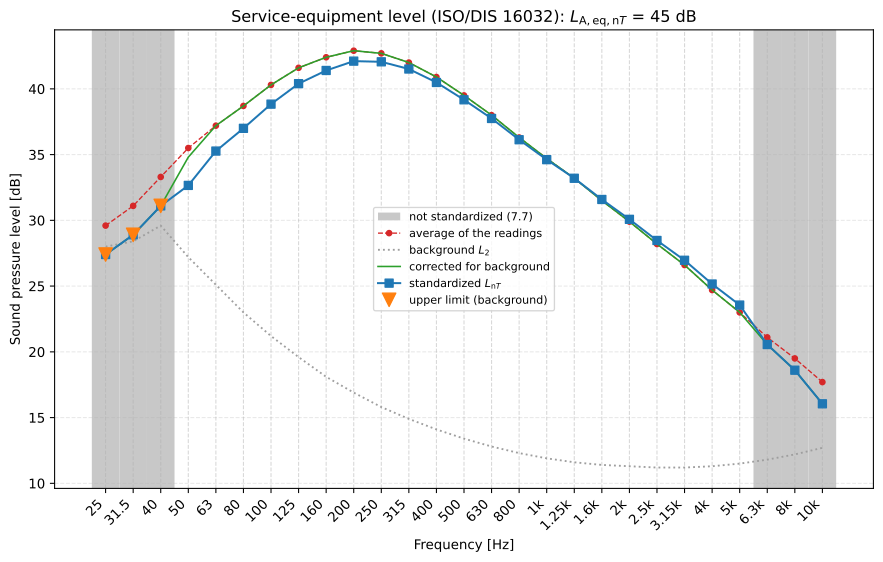
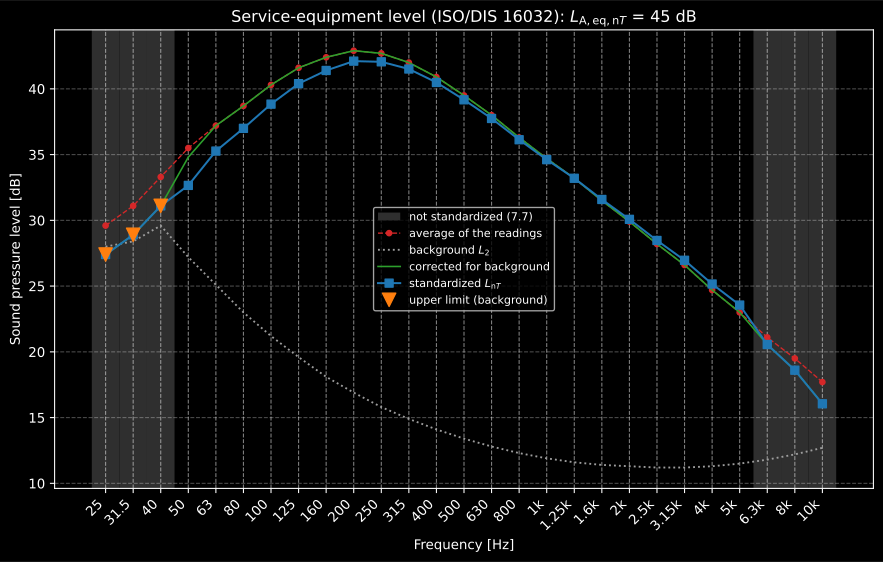
The three lowest bands sit within 4 dB of the background, so their correction is held at 2.2 dB and they are upper limits. They lie in the C-weighted range, which makes an upper limit, and outside the restricted A-weighted range, which leaves unaffected. At 50 Hz and from 6.3 kHz up the background is 5 dB to 9 dB below, and Formula (8) takes 0.5 dB to 1.7 dB off those bands. The standardization lowers the bands where the room is more reverberant than 0.5 s and raises those where it is less, and leaves the six grey bands as they are.
service_equipment_level parameters
Section titled “service_equipment_level parameters”| Parameter | Type | Units | Default | Notes |
|---|---|---|---|---|
levels_db | array | dB | required | Band levels of every reading, (readings, bands); one row for a single reading |
frequencies_hz | array | Hz | required | Nominal centres, increasing: one-third octaves 25 Hz to 10 kHz or octaves 31.5 Hz to 8 kHz |
quantity | str | required | "Smax", "Fmax" or "eq", the Table 1 quantity; it names the single numbers | |
band | str | "third" | "third" or "octave"; Clause 6 asks for one-third octaves, octaves are optional | |
background_db | array | dB | None | One level per band, or one row per position, energy-averaged |
reverberation_time_s | array | s | None | Per band; only 50 Hz to 5 kHz (octaves 63 Hz to 4 kHz) is read, the rest may be nan |
volume_m3 | float | m³ | None | Room volume for the normalized levels; needs the reverberation time |
reference_reverberation_time_s | float | s | 0.5 | of Formula (5) |
a_weighting_range | str | "restricted" | "restricted" (50 Hz to 5 kHz; octaves 63 Hz to 4 kHz) or "extended" (25 Hz to 10 kHz; octaves 31.5 Hz to 8 kHz) |
The result carries average_db, background (the Clause 9 correction),
corrected_db, standardized_db, normalized_db, standardizable,
ratings and unrounded_ratings keyed by Table 1, upper_limit("A") and
upper_limit("C"), unstandardized_bands_hz, reproducibility_db and
weighted_reproducibility_db. The C-weighted values are formed only when the
bands cover the extended range.
For the octave counterpart of the restricted A-weighting range the draft gives no range of its own; the library uses 63 Hz to 4000 Hz, the octave range the draft pairs with 50 Hz to 5000 Hz for the standardization.
Checks on site
Section titled “Checks on site”Beside the method, the draft sets numbers for the measurement itself: how far
the calibration may drift, how long the background is measured, when a
varying background still lets the result stand, when a period was disturbed,
and how far the calculation may stand from the meter. Each check below
returns a verdict with passes (and refuses to be read as True or False
itself) and a .plot().
The calibration (Clause 5)
Section titled “The calibration (Clause 5)”At the beginning and at the end of the measurements the sensitivity of the
instrumentation is verified with a class 1 sound calibrator (IEC 60942). A
calibration that deviates from previous calibrations by more than 0.5 dB
takes the equipment out of use until the reason is clarified and the
sensitivity put right. The limit is new in the revision: the 2004 edition
asked for the two calibrations and set no number.
verify_calibration_deviation holds each reading to every calibration
before it, the earlier ones given and, for the end, the beginning as well; a
deviation of exactly 0.5 dB is not “more than 0.5 dB” and passes. The
readings are compared as levels, so they come from the same calibrator at the
same stated level.
cal = building.verify_calibration_deviation( [94.0, 94.2], # beginning and end of this measurement [dB] previous_levels_db=[93.9, 94.0], # earlier calibrations of the instrumentation [dB])print(np.round(cal.deviations_db, 2), cal.passes) # [0.1 0.3] Truecal.plot()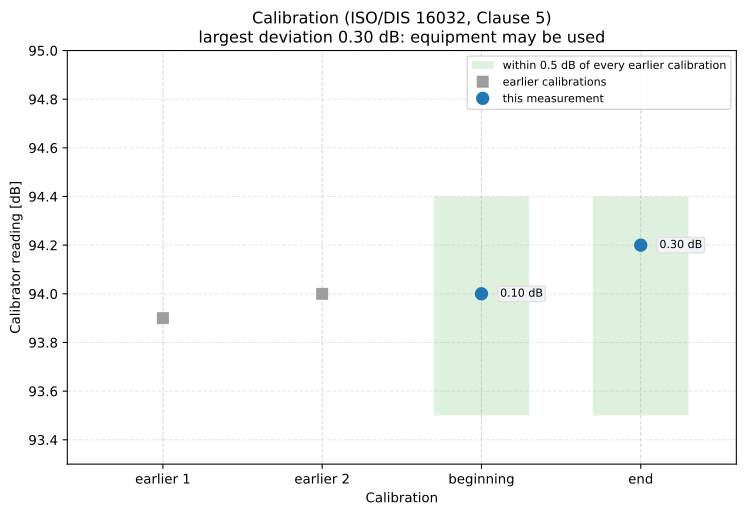
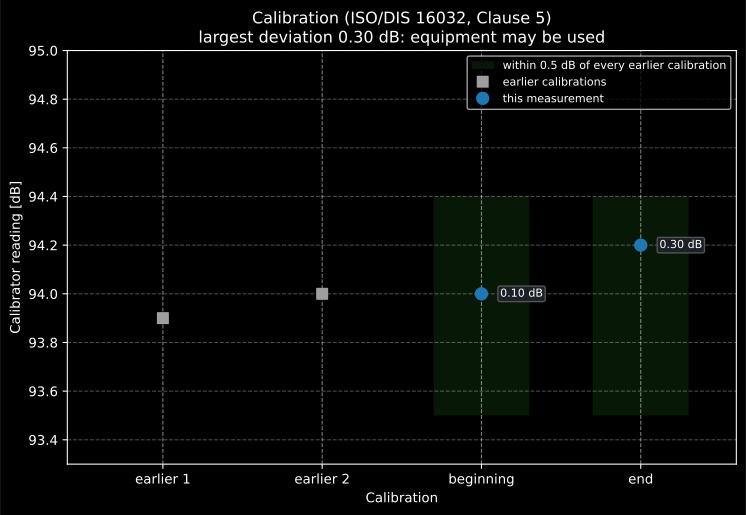
The band over each reading of this measurement is where it would stay within 0.5 dB of every calibration before it. The end, 94.2 dB, is 0.3 dB from the earliest calibration and 0.2 dB from the beginning, so the equipment may be used.
The background measurement (7.6)
Section titled “The background measurement (7.6)”The background is the equivalent level in bands over approximately 30 s just
before or after each set of measurements, at the same microphone positions.
The draft prints no tolerance for “approximately”, so the library sets none:
check_background_duration asks for the departure from 30 s, either way,
that your report accepts as approximate (tolerance_s, a required keyword),
holds each time to it, and reports every departure whatever the verdict. A
departure of exactly the tolerance is within it, and tolerance_s=0.0 holds
each time to 30 s exactly. Whether the background was taken just before or
after each set, and at the same positions, is not a number and stays with the
operator.
duration = building.check_background_duration( [30.0, 31.0, 30.0, 26.5], # measurement time of each background [s] tolerance_s=2.0, # what the report accepts as "approximately" [s])print(duration.departures_s, duration.within_tolerance, duration.passes)# [ 0. 1. 0. -3.5] [ True True True False] Falseduration.plot()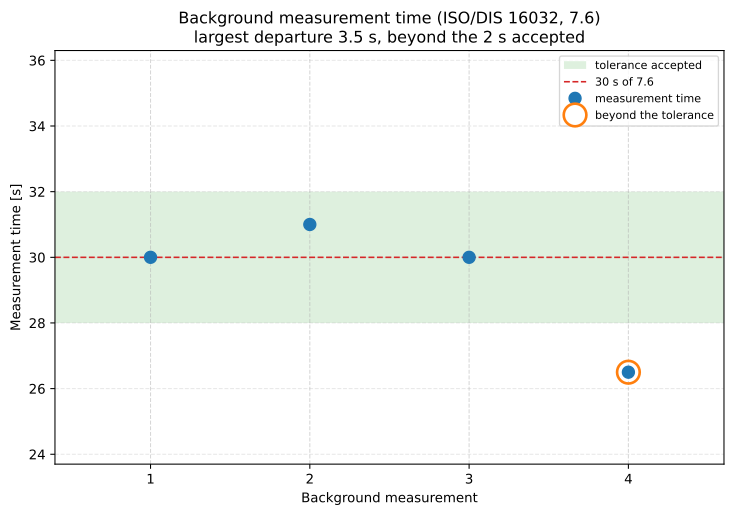
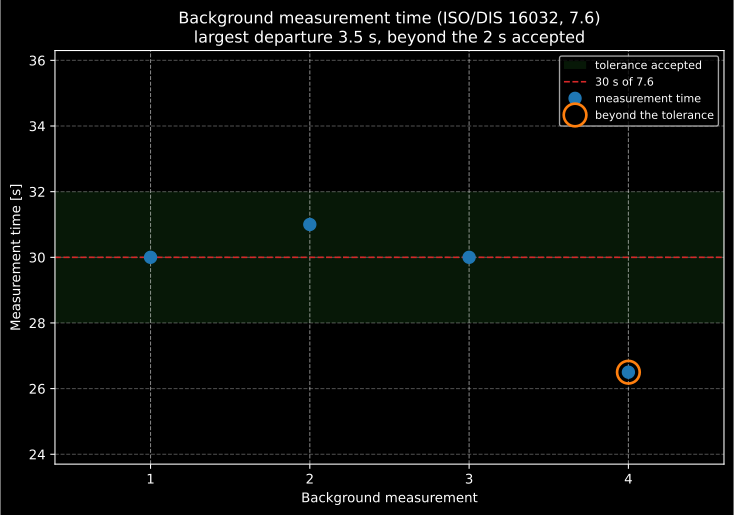
With 2 s accepted either way, the first three backgrounds are approximately 30 s and the fourth, 3.5 s short, is not. Every departure goes in the report, and the tolerance written beside them is what decides.
A background that varies (NOTE to Clause 9)
Section titled “A background that varies (NOTE to Clause 9)”The correction of Clause 9 assumes a background roughly constant in time.
Where it is not, road traffic for example, a reliable correction cannot be
made, and the NOTE to Clause 9 offers another route: watch the maximum level
of the background for 10 min to 15 min at the corner position; if it lies
10 dB or more below the equipment, the result can be regarded valid without
correction. The NOTE asks to check “the validity in all relevant
octave-bands”, words kept from the 2004 edition, which measured in octaves;
check_varying_background judges the margin in every band it is given,
one-third octaves or octaves. Both ends of the period are included, and so is
a margin of exactly 10 dB. The 2004 edition watched “one of the microphone
positions”; the draft names the corner.
octaves = [63.0, 125.0, 250.0, 500.0, 1000.0, 2000.0, 4000.0]varying = building.check_varying_background( [36.5, 35.0, 31.0, 27.5, 24.0, 21.0, 17.5], # background maximum over 12 min [dB] [44.0, 46.5, 43.0, 39.5, 36.0, 32.5, 28.0], # the equipment, same bands [dB] observation_time_s=720.0, frequencies_hz=octaves,)print(varying.margin_ok, varying.passes)# [False True True True True True True] Falsevarying.plot()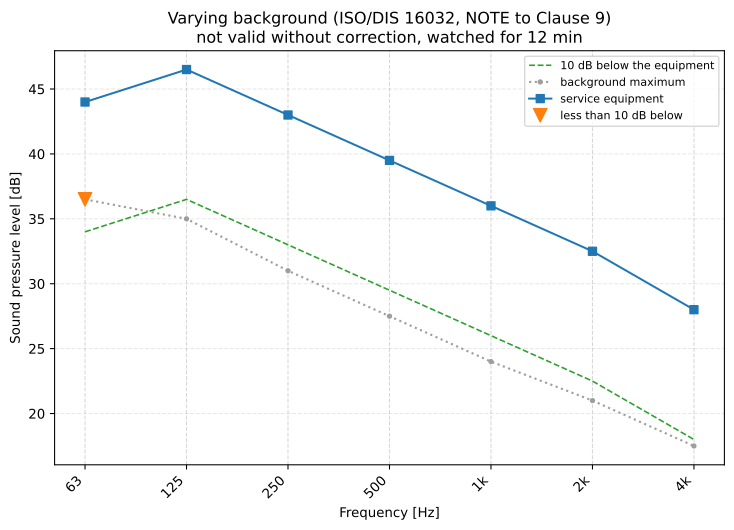
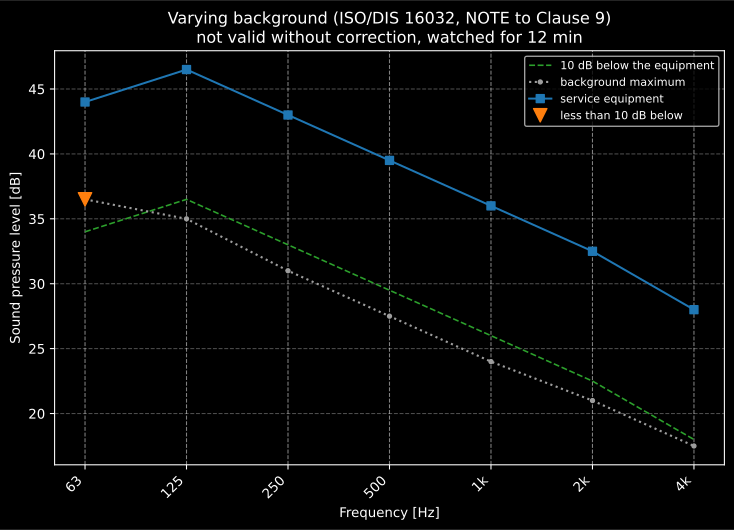
The traffic peaks reach 36.5 dB at 63 Hz, only 7.5 dB under the equipment, so that band is short of the 10 dB the NOTE asks and the result cannot stand without correction there; from 125 Hz up the margin is 10.5 dB to 12 dB.
Disturbed periods (Clause 9)
Section titled “Disturbed periods (Clause 9)”“A simple check on-site” closes Clause 9: compare the maximum level with the equivalent level in the middle of the frequency range during each measurement period. For many stable sources the difference should be less than 5 dB; a larger one says the period was disturbed, by a closing door or footfall for example. The check is new in the revision. It holds for stable sources, not for one whose own level varies, and the draft names the band only as “the middle of the frequency range”, so the operator chooses it. A difference of exactly 5 dB is not less than 5 dB and marks the period.
periods = building.check_measurement_disturbance( [41.6, 42.0, 48.9, 41.3, 41.8, 42.2], # maximum of a mid-range band, per period [dB] [39.0, 39.4, 41.1, 38.9, 39.2, 39.6], # equivalent level, same band and periods [dB])print(np.round(periods.differences_db, 1), periods.disturbed_periods)# [2.6 2.6 7.8 2.4 2.6 2.6] (2,)periods.plot()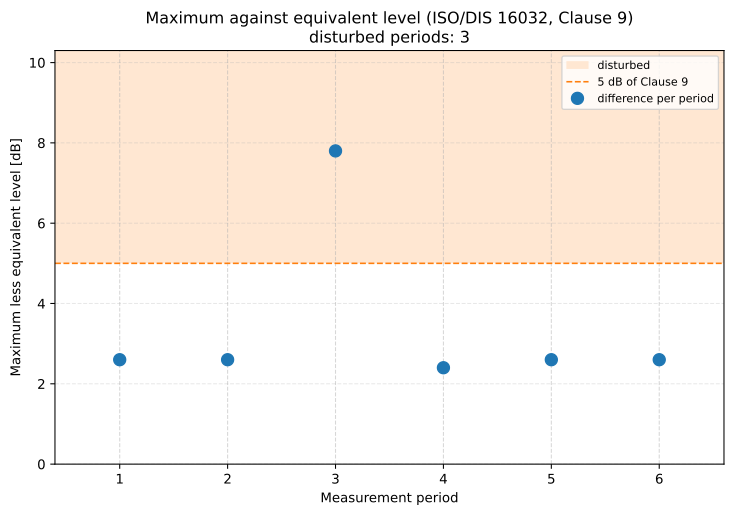
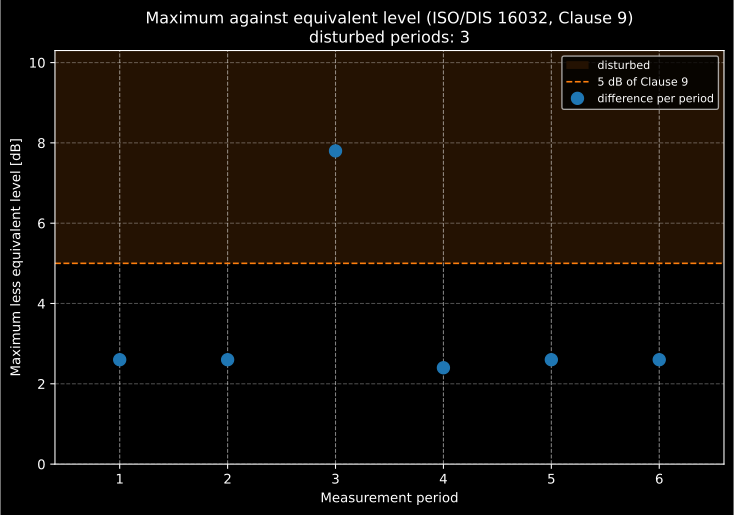
In five periods the maximum sits 2.4 dB to 2.6 dB above the equivalent
level; in the third it sits 7.8 dB above, and that period was disturbed.
disturbed_periods counts from 0, the figure from 1.
The calculation against the instrument (NOTE to 7.8)
Section titled “The calculation against the instrument (NOTE to 7.8)”The NOTE to 7.8 suggests comparing the corrected and calculated A- and
C-weighted results with the values the instrument registered: more than
2 dB apart, the calculations should be checked for possible explanations. The
NOTE is new in the revision. check_instrument_agreement takes the result and
the instrument’s value for each single number, keyed by its Table 1 notation;
a reading at each position is energy-averaged by Formula (1). The calculated
value is the single number as 7.8 rounds it, and exactly 2 dB agrees. A
background correction or a standardization can account for a difference by
itself, which is the kind of explanation the NOTE asks for.
agreement = building.check_instrument_agreement( res, {"LA,eq": [46.0, 44.5, 45.8], "LC,eq": [52.3, 50.8, 52.1]})print({k: round(v, 1) for k, v in agreement.differences_db.items()}, agreement.passes)# {'LA,eq': -0.5, 'LC,eq': 0.2} Trueagreement.plot()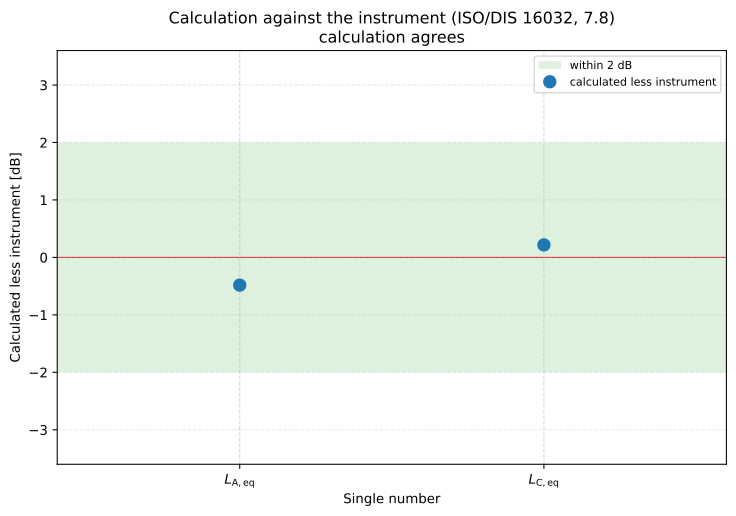
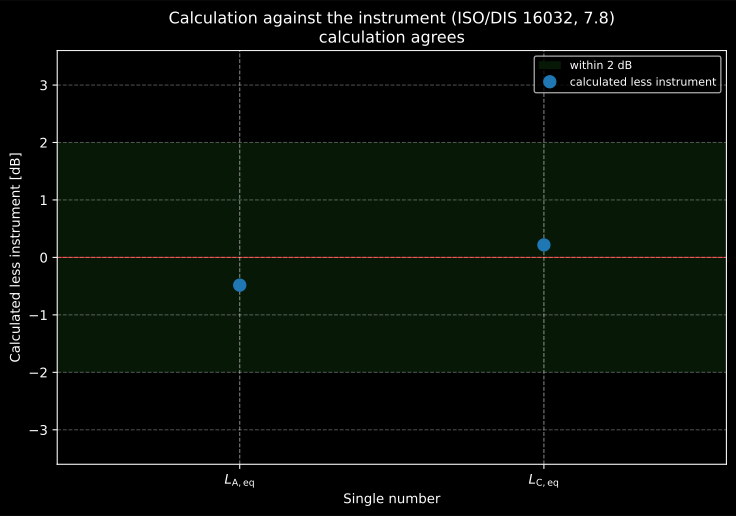
The meter read 44.5 dB to 46.0 dB A-weighted and 50.8 dB to 52.3 dB C-weighted at the three positions of the water closet example. Their energy averages lie 0.5 dB above the calculated = 45 dB and 0.2 dB below = 52 dB, well inside 2 dB.
Operating conditions (Annex B)
Section titled “Operating conditions (Annex B)”How the equipment runs while it is measured decides the number as much as the
microphones do. Annex B is normative, but national requirements and
regulations take precedence (B.1.1), and equipment it does not list is
measured by its principles with the chosen conditions reported in detail.
SERVICE_EQUIPMENT_OPERATING_CONDITIONS holds each entry as data:
| Key | Clause | Maximum level | Equivalent level |
|---|---|---|---|
water_tap | B.2.2 | a single tap: open fully, wait, close; a hot and cold mixer: hot tap open, then cold, closed in the same order; single-lever, flow and temperature, and thermostatic mixers: through the temperature range | about 30 s at the loudest setting; for single-lever, flow and temperature, and thermostatic mixers the highest of the average, hot and cold settings |
shower_cabin | B.2.3 | as a tap | as a tap |
bath | B.2.4 | as a tap, and the shower; without a wall fixture the shower is held about 1.5 m above the tub bottom | as a tap |
filling_emptying | B.2.5 | filling, then emptying | the filling period and the emptying period, half full |
water_closet | B.2.6 | a full flushing and refilling cycle | the same cycle |
mechanical_ventilation | B.3 | about 30 s at the loudest setting | about 30 s |
heating / cooling | B.4 | start from cold, full load, each appliance / about 30 s | about 30 s |
lift | B.5 | 1 or 2 persons, up to five floors each way, at least three repetitions | the same cycle |
rubbish_chute | B.6 | two PVC tubes, 0.1 m long, 50 mm across, 0.7 kg/m | not measured |
auxiliary_equipment | B.7 | start, operate, stop; or a full automatic cycle | the cycle |
car_park_door | B.8 | opening and closing | a full cycle |
other_equipment | B.9 | the cycle of normal use | the cycle |
unknown_source | B.10 | several 30 s periods in the loudest hour of normal operation |
B.10 is the new part. An activity, a restaurant’s coolers or live music next door, is measured in normal operation, automatic controls suspended where needed, over several 30 s periods within the hour the level is expected to be highest, leaving out downtime and minor irregular events. Where the sound is too irregular for the corner search, the acoustically most reflective corner becomes position 1, and the report says so. Where no operating cycle can be defined at all, the equivalent level is averaged until it is stable, and not for less than 30 s (B.1.3).
wc = building.SERVICE_EQUIPMENT_OPERATING_CONDITIONS["water_closet"]print(wc.clause, wc.equivalent_cycle)# B.2.6 a full flushing and refilling cyclechute = building.SERVICE_EQUIPMENT_OPERATING_CONDITIONS["rubbish_chute"]print(chute.equivalent_level, chute.parameters["tube_length_m"]) # False 0.1Precision (Clause 10)
Section titled “Precision (Clause 10)”Table 2 estimates the reproducibility standard deviation of a room-average band level from a limited number of measurements of steady sources:
| One-third-octave bands | Octave bands | |
|---|---|---|
| 25 Hz to 160 Hz | 31.5 Hz to 125 Hz | 1.9 dB |
| 200 Hz to 315 Hz | 250 Hz | 1.5 dB |
| 400 Hz to 630 Hz | 500 Hz | 1.2 dB |
| 800 Hz to 10 000 Hz | 1000 Hz to 8000 Hz | 1.0 dB |
| A-weighted | 0.8 dB | |
| C-weighted | 1.2 dB |
The two weighted values hold for a steady sound with a relatively flat
spectrum from 25 Hz to 10 kHz, at least 10 dB above the background. A source
that fluctuates raises the uncertainty, the maximum levels most of all. The
result carries the band values as reproducibility_db and the value of each
single number, keyed like ratings, as weighted_reproducibility_db; the
tables are SERVICE_EQUIPMENT_REPRODUCIBILITY and
SERVICE_EQUIPMENT_WEIGHTED_REPRODUCIBILITY. The draft states no coverage
factor, so the library does not form an expanded uncertainty.
print(dict(res.weighted_reproducibility_db))# {'LA,eq': 0.8, 'LC,eq': 1.2, 'LA,eq,nT': 0.8, 'LC,eq,nT': 1.2, 'LA,eq,n': 0.8, 'LC,eq,n': 1.2}What the revision changes
Section titled “What the revision changes”Against the withdrawn ISO 16032:2004, the draft:
- widens the scope from installed service equipment to activities and unknown sources in or near the building (B.10);
- measures in one-third-octave bands, octaves being optional, where 2004 measured in octaves only;
- sets the number of positions by the spread ladder of 7.4.1, where 2004 took two corner readings and measured each position as many times as the difference between them in whole decibels;
- standardizes 50 Hz to 5000 Hz (octaves 63 Hz to 4000 Hz) only;
- sums the A-weighted value over 50 Hz to 5000 Hz or 25 Hz to 10 000 Hz, where 2004 used octaves 63 Hz to 8000 Hz (31.5 Hz to 8000 Hz for C);
- relaxes the reverberant-field positions: 1.0 m apart at least (2004 asked 1.5 m), 0.50 m from surfaces (0.75 m) and up to 2.0 m high (1.5 m);
- raises the low-frequency reproducibility of Table 2 from 1.5 dB to 1.9 dB and the C-weighted one from 1.1 dB to 1.2 dB;
- takes the equipment out of use when a calibration deviates from previous calibrations by more than 0.5 dB, where 2004 asked for the calibrations and set no limit;
- adds two on-site checks, a maximum less than 5 dB above the equivalent level in each period and calculated results within 2 dB of the instrument;
- watches the maximum of a varying background at the corner position, where 2004 used any one of the positions.
Verifying it without a worked example
Section titled “Verifying it without a worked example”The draft prints no worked example, so the conformance rows stand on what it does print and on closed forms. Printed: the 2.2 dB a 4 dB background margin gives (Clause 9), the 36 A-weighting cells of Table A.1, its C-weighting cells with the ten misprinted ones taken from IEC 61672-1, and the 38 cells of Table 2. Closed forms: the band average of three readings, a reverberation time of lowering exactly 50 Hz to 5000 Hz (octaves 63 Hz to 4000 Hz) by , an equivalent absorption area of 16 m² normalized to m² gaining dB, the A- and C-weighted sums of a flat spectrum and their rounding half up to whole decibels, the thresholds of Clause 9 met by levels given to 0.1 dB, the thresholds of 7.4.1 at their boundaries, every distance and height limit of 7.3, and the corner height and preferred wall distance of 7.2, met exactly and missed by 0.01 m, and the positions 7.9 places in front of a wall source and below a ceiling one. The checks on site stand on the limits the draft prints, each met exactly and missed: the 0.2 m from an obstacle, the 0.5 dB calibration deviation, the 10 min to 15 min and the 10 dB of a varying background, the 5 dB between the maximum and the equivalent level, and the 2 dB between calculation and instrument, with the instrument above the calculation and below it. A difference of decimal readings that lands a hair off its limit in binary, 40.3 dB over 30.3 dB for the 10 dB for instance, still reads as the limit. Since the draft prints no tolerance for its 30 s, the background row gives its own (0 s, 0.3 s and 1 s) and holds 30 s to each, met exactly and missed above and below.
Quick answers
Section titled “Quick answers”Why does the C-weighted value differ from Table A.1 as printed?
Section titled “Why does the C-weighted value differ from Table A.1 as printed?”Because the table misprints it. The draft’s one-third-octave C-weighting column reads 0 dB in every band from 1600 Hz to 10 000 Hz and −5 dB at 25 Hz, which contradicts its own octave column (−0.2, −0.8 and −3.0 dB at 2, 4 and 8 kHz) and IEC 61672-1 (−0.1 dB to −4.4 dB from 1600 Hz up, −4.4 dB at 25 Hz). The library uses the IEC 61672-1 values in those ten cells, from Table 3 of IEC 61672-1:2013, which the frequency weighting implements; read as printed, a flat spectrum would sum 0.4 dB higher. The defect is in the errata registry.
Are the 25 Hz and 10 kHz bands standardized?
Section titled “Are the 25 Hz and 10 kHz bands standardized?”No. 7.7 standardizes and normalizes only 50 Hz to 5000 Hz, because the
reverberation time outside cannot be measured reliably. The outer bands enter
the weighted sums as corrected, and unstandardized_bands_hz lists the ones
that do, for the report.
Can I use it for the bar downstairs?
Section titled “Can I use it for the bar downstairs?”Yes: that is what B.10 adds. Run the activity normally, measure several 30 s periods in its loudest hour, and treat each set of three positions exactly as for a service equipment. Where the sound is too irregular to find the loudest corner, use the most reflective one and report the deviation.
Does a background measured over 28 s pass?
Section titled “Does a background measured over 28 s pass?”Only if the tolerance you give allows it. 7.6 asks for “approximately 30 s”
and prints no tolerance, so check_background_duration asks you for one
(tolerance_s) rather than decide how much “approximately” allows: with 2 s
accepted, 28 s passes; with 1 s, it does not. Either way the 2 s departure is
reported, the tolerance goes in the report beside it, and nothing else in the
method changes.
Is the result an upper limit?
Section titled “Is the result an upper limit?”When a band of the weighted range was within 4 dB of the background, yes:
upper_limit("A") and upper_limit("C") say which single number is, and the
report has to state it.
Standards
Section titled “Standards”Covered
The engineering method of ISO/DIS 16032:2023, the draft of the second edition of ISO 16032, read in E DIN EN ISO 16032:2023-05: the Table 1 quantities, the corner search of 7.2 and the distances of 7.3 for a rectangular room, the position ladder of 7.4.1 with the corner standard deviation, the additional position of 7.9 for a source in the room, the band average of Formula (1) rounded to 0.1 dB, the background correction of Clause 9 held at 2.2 dB, standardization and normalization by Formulae (5) and (6) over 50 Hz to 5000 Hz, the A- and C-weighted sums of Formulae (2) and (3) over the ranges of 7.8 rounded to whole decibels, Table A.1 (with the misprinted C-weighting cells from IEC 61672-1), Table 2, and the operating conditions of Annex B as data, the activities of B.10 included. The checks on site: the 0.2 m from obstacles of 7.2 from a measured distance, the 0.5 dB calibration deviation of Clause 5, the 30 s background of 7.6 against the tolerance the operator gives, the 10 min to 15 min maximum of a varying background and its 10 dB margin (NOTE to Clause 9), the 5 dB between the maximum and the equivalent level of Clause 9, and the 2 dB comparison with the instrument of the NOTE to 7.8.
Not covered
The draft is not the published standard: where ISO 16032:2024 differs, this page follows the draft. The library does not record the multispectral time trace or find the instant of the maximum: it takes the band levels at that instant as given. The checks on site judge numbers the operator measures and passes in; they do not decide what is not a number: which corner is the loudest, whether the background was taken just before or after each set and at the same positions, which band is “the middle of the frequency range”, or whether a source is stable enough for the 5 dB check. “Approximately 30 s” has no tolerance in the draft, so the library sets none: the operator names the one the report accepts. Nothing checks the room volume of about 300 m³ or less that Clause 1 intends the method for. The “specific frequency range” that 4.2 admits beside the two ranges, and that the form of Annex C has a box for, is not offered: 7.8 forms the weighted values over the restricted or the extended range only, and a band set that does not cover the chosen range is refused. No
.report()fiche is produced: the building fiches are drawn around an ISO 717 reference curve that this method does not have. There is no printed worked example, so no row reproduces one.
References
Section titled “References”- International Organization for Standardization. (2004). Acoustics — Measurement of sound pressure level from service equipment in buildings — Engineering method (ISO 16032:2004). The first edition, which the draft revises and which is withdrawn. Read in BS EN ISO 16032:2004 for what changed: octave bands only, a position count set by two corner readings, and no activity sources.
- International Organization for Standardization. (2021). Acoustics — Field measurements of airborne and impact sound insulation and of service equipment sound — Survey method (ISO 10052:2021). The survey method for the same quantities: three A- or C-weighted readings, no band analysis, and the reverberation index in place of a measured reverberation time.
- International Organization for Standardization. (2023). Acoustics — Measurement of sound pressure level from service equipment or activities in buildings — Engineering method (draft international standard) (E DIN EN ISO 16032:2023-05). The draft ISO/DIS 16032:2023 of the second edition (prEN ISO 16032:2023) in its German publication, German and English text, and cited as a draft. Every clause number on this page is the draft's. Six printed defects are in the errata registry, the C-weighting of Table A.1 among them.